HighSep12

  • Subscribe to our RSS feed.
  • Twitter
  • StumbleUpon
  • Reddit
  • Facebook
  • Digg

Wednesday, 31 July 2013

Roanoke's Finest

Posted on 03:45 by Unknown


The alarm sounds. Conversation abruptly ceases. A scramble ensues. Controlled mayhem. Followed closely on by disciplined, practiced, unhesitating, focused preparation.

Preparing to do what they do best. What they're trained to do. What's expected of them. What they demand of themselves. Roanoke's finest.

Lives are at stake. In every case. On every run. Civilians' lives most importantly. Firefighters' lives always.

Not to mention exhaustion. Dehydration. The potential for smoke inhalation. Injury. Worse.

Every day.

It comes with the territory. It's all part of a firefighter's accepted job duties and responsibilities: Be prepared to save lives and in the attempt, be prepared to risk your own. While most of us complain if the company coffee maker is broken or the wastepaper basket wasn't emptied overnight, firefighters hope their oxygen masks don't fail them. We want our work environment to be comfortable, air conditioned, and brightly lit. Firefighters hope theirs doesn't include combustible materials or explosives or toxic chemicals. Projectiles. A good day for most of us is one in which the boss doesn't give us a whole lot to do. For a firefighter, it's being able to go home at the end of the day. To be able to spend time with the children. To look in their little eyes and resolve to never let them know of or to witness the horrific sights they've seen. The anguish. The grief. The heartbreak. The mangled bodies.

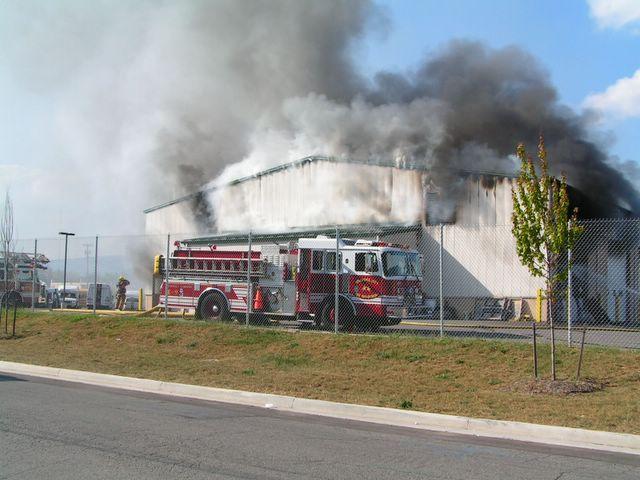
On this particular day, a fire erupted in a maintenance garage when a can full of gasoline ignited and set a bus on fire. When the fire department arrived, smoke was pouring from the windows and doors.

I've been witness to some building fires in the past. I remember one in particular, many years ago, that engulfed a faculty office building at the university I was attending. It was very cool. Exciting. Fun.

But I could stand at a distance with my classmates and watch the drama from afar. The smoke billowing up. The flames shooting through the roof.

I could stand by and take pictures of the raging inferno. Firefighters are trained to run into its midst. Selflessly. Without hesitation. Without regard to the many hazards in store. Lives deemed more important than their own - somehow - are at stake. They act.

I'm not sure I'm capable of such things. I doubt that most of us are. Sure, we all dream of performing an heroic act. Of saving a life. Of dragging the unconscious victim of that car wreck to safety. And of living to tell the tale on Larry King Live.

These guys risk everything every day. And Larry King pays no notice. But they do it anyway. With pride. Determination. It's a calling.

They deserve our everlasting and heartfelt thanks for being there and for protecting our loved ones - our children and grandchildren - from harm.

The firefighter, by the way, pictured above with axe in hand heading into the flames is my son, Jarrod Fuhrman, Station # 3, Roanoke Fire/EMS.

Photos courtesy of Lt. Rhett Fleitz, Roanoke Fire/EMS & Roanoke Firefighters
Click on images to enlarge.
Read More
Posted in | No comments

Tuesday, 30 July 2013

On Veterans Day

Posted on 04:40 by Unknown
(Originally published on November 11, 2011.)


This handsome young man, who - some say - bears a striking resemblance to his offspring, is being honored this day - Veterans Day - for his service to his country.

Harold Fuhrman, son of Heinrich and Ida Majeske Fuhrman, joined the United States army in 1942 and became one of the legenday "Screaming Eagles" of the renowned 101st Airborne Division - made famous in both the movie, "Saving Private Ryan," and in the HBO mini-series, "Band of Brothers." The 101st Airborne first saw combat action the night before D-Day, June 5, 1944, just hours before the Allied invasion of Nazi-occupied Europe. The division parachuted and glided into Normandy - northern France - behind German lines with the purpose of disrupting Nazi communications and preventing counterattacks when the naval assault on the Normandy beaches began the next day.

According to military planners, because of the nature of the task before them - night attack, units scattered across the Normandy countryside, powerful German defenses in the immediate area, no support from the naval assault taskforce for at least a day or longer - it was expected that the division would suffer horrendous casualties in the assault. And it did. 1240 men were either killed or wounded in a matter of a few days and a considerable number went missing. Included on the list of missing in action, a dreadfully long list, was the name Harold Fuhrman.


That assault proved to be Harold's one and only combat experience. He was captured near Ste-Mere-Eglise, became officially a Prisoner of War, and spent the next year being transferred from one German prison camp to another, all the while losing weight as a result of poor dietary conditions, losing some teeth as a result of unsanitary living conditions (eventually he'd have them all removed), but never losing his American spirit.

Harold Fuhrman was liberated from a hellhole of a prison camp near Küstrin
, on the German border with Poland in April of 1945 by the Russian army and, after walking from eastern Germany to the Black Sea in the Crimea in order to find transportation home, Harold made his way back to the USA.

After the war ended, like millions of other veterans, Harold Fuhrman returned home and went back to work. He married Lorraine Riehle and eventually raised a fine family - three sons and a daughter.

He rarely spoke of his war experiences. But when he did, the accounts were startling, the details sobering. He once related the story of the death of a soldier near him and the odd sound that a bullet makes when it impacts the human skull. Like a rock thudding into a pool of water.

He also - once - revealed a scar near his knee that resulted from a wound that he sustained in battle, one for which he received no Bronze Star or Purple Heart. No handshake from the President of the United States. No interview with the news media. By the time he made his way back to his unit after being liberated, it had been long healed and - as was the norm in that era - it was a minor wound, one that didn't rise to the level warranting a medal. Those were indeed different times. As William Halsey said back then, "There are no extraordinary men ... just extraordinary circumstances that ordinary men are forced to deal with." Harold Fuhrman's wound was ordinary - in that extraordinary era - and he thought no more about it. Life went on.

Harold also told the story of his trek across southeast Europe after he was freed and of his having come upon a field where a battle had taken place sometime previously. The field was strewn with the decaying bodies of German soldiers left to decompose where they lay; the Russians had more important matters at hand than to take the time to bury their dead enemies. Harold stripped the winter coat from one of the corpses and moved on. Such were the times.

Harold Fuhrman lived a long life. A good life. Though he was never recognized for his service to - or particularly for his sacrifice for - his country, he was proud of that which he'd been able to contribute. He never asked for recognition. He sought no medals. He considered his enlistment and substantial sacrifices as part of his duty to his country; the country that he held dear every day of his life - one for which he had tremendous gratitude, in which he had terrific pride.

Harold Fuhrman is dead now and buried in a lonely cemetery in rural Indiana. A military marker atop his grave simply reads, "Harold Fuhrman, 101st Airborne Div., WWII." It is as he would have wanted it. Simple. Unassuming. No embroidery. He served his country and that was that.

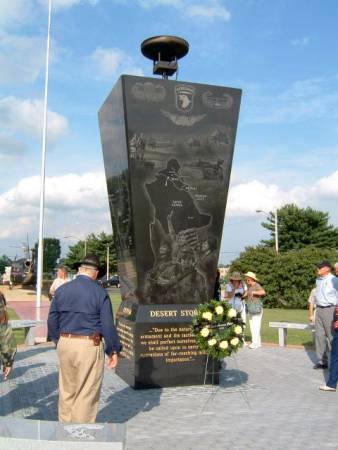
Even though he might have been embarrassed by it, his children decided to honor his service to the United States of America by placing a memorial - one tiny commemoration among thousands of similar remembrances - in the World War II Memorial at Fort Campbell, KY, home to the 101st Airborne Division. It is there for all the world to see and will be there for all time. Without his knowing it then, what he and his fellow soldiers did to preserve freedom for the entire western world has gone down in history. He and they are now honored by a thankful nation - and a respectful family - and will be forever.

Harold Fuhrman's children - Steve, Randy, Suellen, and Jerry - take time out to remember their father this Veterans Day.


JUST A COMMON SOLDIER(A Soldier Died Today)
by A. Lawrence Vaincourt
.

He was getting old and paunchy and his hair was falling fast,
And he sat around the Legion, telling stories of the past.
Of a war that he had fought in and the deeds that he had done,
In his exploits with his buddies; they were heroes, every one.
.
And tho' sometimes, to his neighbors, his tales became a joke,
All his Legion buddies listened, for they knew whereof he spoke.
But we'll hear his tales no longer for old Bill has passed away,
And the world's a little poorer, for a soldier died today.
.
He will not be mourned by many, just his children and his wife,
For he lived an ordinary and quite uneventful life.
Held a job and raised a family, quietly going his own way,
And the world won't note his passing, though a soldier died today.
.
When politicians leave this earth, their bodies lie in state,
While thousands note their passing and proclaim that they were great.
Papers tell their whole life stories, from the time that they were young,
But the passing of a soldier goes unnoticed and unsung.
.
Is the greatest contribution to the welfare of our land
A guy who breaks his promises and cons his fellow man?
Or the ordinary fellow who, in times of war and strife,
Goes off to serve his Country and offers up his life?
.
A politician's stipend and the style in which he lives
Are sometimes disproportionate to the service that he gives.
While the ordinary soldier, who offered up his all,
Is paid off with a medal and perhaps, a pension small.
.
It's so easy to forget them for it was so long ago,
That the old Bills of our Country went to battle, but we know
It was not the politicians, with their compromise and ploys,
Who won for us the freedom that our Country now enjoys.
.
Should you find yourself in danger, with your enemies at hand,
Would you want a politician with his ever-shifting stand?
Or would you prefer a soldier, who has sworn to defend
His home, his kin and Country and would fight until the end?
.
He was just a common soldier and his ranks are growing thin,
But his presence should remind us we may need his like again.
For when countries are in conflict, then we find the soldier's part
Is to clean up all the troubles that the politicians start.
.
If we cannot do him honor while he's here to hear the praise,
Then at least let's give him homage at the ending of his days.
Perhaps just a simple headline in a paper that would say,
Our Country is in mourning, for a soldier died today.

Memorial photo coutesy of the 101st Airborne Division Assn.
Read More
Posted in | No comments

Monday, 29 July 2013

A Soldier's Story

Posted on 04:42 by Unknown
Andrew Jackson Grayson was a miller by trade. He built and operated his place of business along Little Walker Creek here in Bland County, Virginia back before there was a Bland County. This area was sparsely settled and life was "hardscrabble," as it were. It is probably because his mill was frequented by all the farmers in the area who came to him to have their meager harvest ground into meal and he was, therefore, a familiar figure to everyone in the area, that when the Civil War broke out, Andrew Jackson Grayson was elected by the Confederacy's new recruits to the cause to be captain of the newly formed "Bland County Sharpshooters."

The victory at Fort Sumter had occurred only a month before and the South was a'risin '. All over the country the call went out for recruits to join the army and defend against northern aggression. Young men from the area packed what little they had and made the journey over the mountain to Wytheville, the only town in the area, and to Narrows in Giles County to enlist. When the company had enough recruits, its official designation became Company F, 45th Regiment, Virginia Volunteers. What an adventure it must have been for these boys, most of whom had probably never been far from home, to be given weapons and "accoutrements" (and an expansion of their vocabulary) and to find themselves on the parade ground in Wytheville learning how to conduct themselves in battle, and about "Hardee's Rifle and Light Infantry Tactics." For the first time in their lives they were not only playing a part in something important, they were making history.


And then they went to war. Their first encounter with the enemy was on a hilltop in Nicholas County in what was about to become, as a result of the South having seceded, the state of West Virginia in a place called Carnifex Ferry. Here they learned the word retreat. For after inflicting serious casualties on the advancing northern force, the Confederate army under General John Floyd slipped away and moved south. There is no record of the company sustaining any casualties but here the company of Bland boys got their first experience with that which killed the greatest number of soldiers north and south - sickness and disease. Though the company of recruits wasn't there long, when they left Nicholas County, they left behind a freshly dug grave containing the mortal remains of their first fatality, a young man who succumbed to a nameless illness, who died, and was buried - alone and with but a stone to mark his grave.


Over the next four years the company of Bland boys saw war in far away locations in Tennessee, West Virginia, and finally in "the big show," in Virginia as a part of the Army of the Valley. They fought in many places that today don't even warrant mention in the history books. Places like Wolf Creek, White Sulfur Springs, Diamond Hill, Mossy Creek, and Talbot's Station. They also participated in many of the war's larger engagements at Winchester, Opequon Creek, Cloyd's Mountain, Monocacy, Fishers Hill, and Piedmont.


With each encounter, the Bland Sharpshooters counted more dead. Upon leaving each encampment, Company F, 45th Virginia Volunteers left behind sick, wounded, and dying youth. For four years the boys from Bland County endured unspeakable hardship and privation. They lacked proper clothing in winter, were denied proper nutrition throughout, and often went days without food of any kind at all. In most of their encounters with the enemy, they were outnumbered by an army much better equipped and armed.


But they endured. In the end, the company of Bland boys didn't go through the formal surrender ceremony that one reads about in history books or sees in famous paintings. When notified of Lee's surrender at Appomattox, the regiment simply disbanded - and what remained of the Bland Sharpshooters went home.


Andrew Jackson Grayson enlisted in Company F on May 31, 1861 and became the company's captain shortly thereafter. When the company disbanded, "Captain Jack" was still the commander of the Sharpshooters. One wonders what history he made. In a war that saw so much attrition, it was not unusual for a private soldier to find himself being chosen for the rank of an officer and, as superior officers were killed off or died or went home maimed or broken, to be promoted again. And yet Andrew Grayson was Captain of Company F for all four years of the war. 


One wants to think that it was his decision to stay with "his boys" and that he chose not to take on greater rank. It could be though that his performance was recognized as being adequate enough to supervise the company but he was not considered capable of taking on greater responsibility. Or, as with the case with many officers in both armies, he may have been sick and in hospital too often to be considered for promotion. Or it is possible that Capt. Grayson and the 45th were, as was the case with many of the mountain regiments, inclined to be a bit too "independent" and could be counted on to fight like devils when called upon, but were impossible to control otherwise. 


We'll never know. As for me, I prefer to think he simply and honorably wanted to fulfill his obligation to "his Bland boys" and remained with Company F throughout. Even with all the diaries, memoirs, and regimental histories that were written about the period, nobody took the time to chronicle the life of Andrew Jackson Grayson. All we know is that when the war ended, he dismissed the troops and went back to his mill along Little Walker Creek.


There is one story, though, that is told in these parts about Captain Jack and his mill. In July 1863, while Capt. Grayson was "down the valley" fighting Yankees (and incidentally while Robert E Lee was retreating from a tiny town in Pennsylvania by the name of Gettysburg), a Union army was moving through Bland County on its way to burn the train station and railroad bridge in Wytheville. As became the norm in this horrific conflict, the Union troops wreaked destruction on the local economy and Confederate war-making capability as it moved south by burning barns and any manufactory along its route that could be used for making war material. This happened to include grain mills in that they often provided corn meal to the Southern army.


In this instance, though, luck was on Andrew Grayson's side. When the Union army came upon his mill and Yankee soldiers were about to set it afire, the Union commander ordered the soldiers to cease. As it turns out, he was a miller too and, despite the animosities and hostilities that had grown between the two sides, he decided to spare Grayson's property.


There exist remnants of Grayson's mill and dam along the creek today. Though Captain Jack Grayson's home is long gone. I can look out my window - and often do - at his homestead and think about Andrew Jackson Grayson and the boys of '61. What they went through. What part of history they wrote. What memories they had and shared in reunions in later years when they got together in town and reminisced about the war years. 


I have seen only one photograph of Captain Grayson. It was taken at a reunion of Bland veterans some time in the late in the 19th century. It was an assemblage of about fifteen elderly men, gray, bearded and bowed. There in the center of the group was Captain Jack. Try as I might to get a good look at him and to try to gain an understanding of his person, the photo was too unclear and was taken from too far away. He was just a small figure among small figures on a big hillside. I can only guess that their conversations about great battles and many triumphs were tinged with profound sadness - for most of the Bland boys who marched off to war in 1861 never returned. As was customary, many perished without even a marker to identify their remains. They vanished.


Captain Andrew Jackson Grayson was, in that sense, luckier. On a hillock that gently rises above Little Walker Creek that would have been a short walk for him from his home, on land that now includes my home, there is a solitary grave in a grass pasture overlooking his mill. There Captain Jack - miller, warrior, citizen - rests.


* Originally published on August 11, 2004


Read More
Posted in | No comments

Friday, 26 July 2013

Kaid Becomes a Man

Posted on 05:49 by Unknown
Two-year-old Kaid Fuhrman climbed up to my tree house this evening and, in the course of things, decided to relieve himself. He dropped his drawers and peed on the countryside below. Kaid is now a man. It brought tears to my eyes. Today peeing out of the tree house, tomorrow telling lies to some large-breasted woman in a smoke-filled honky-tonk. How quickly they grow up.

* Originally published on August 12, 2004.
Read More
Posted in | No comments

Chaos and the Morning Feeding

Posted on 04:22 by Unknown
"For the love of God. Make them stop!" Terror set in as I tried to escape the churning mass of feline savagery. There have been few moments in my long life when I felt that I was in great danger but this was one of them. A feeling of impending doom swept over me and caused me to retreat to the corner of the kitchen - until I felt the microwave countertop against my back and I realized that my escape route was cut off. It was at this point that I cried out for God's mercy and for the Bland County Rescue Squad to save me from what was assuredly certain death.

It was cat feeding time at the Fuhrman house.

I know. You think of them as fuzzy, cuddly, purring little darlings curled up in front of the fireplace. Step into my kitchen at 6:05 in the morning and you'll step back with a bloody stump where your foot was attached only a moment before. These little monsters have a schedule and, by damn, you'd better adhere to it or there's all hell to pay.

It's all my wife's fault. Paula thinks she is doing the world a favor by bringing stray cats into the home and providing for them in a manner that all the children of Sub-Saharan Africa would envy. She doesn't just feed them and wipe their tiny butts (OK. I'm exaggerating a bit).
She has a schedule.

And they know it.

I should probably take the time to introduce the individuals who have turned our loving, nurturing home into San Diego Zoo East. I'm not sure I know all their names and Paula, being the sinister person that she is, sometimes sneaks new cats into the pile without telling me. If it weren't for the fact that I can now recognize each individual shriek they emit, starting at 5:55am, I wouldn't be able to tell one from another. That plus the fact that each has a discernable butt (I learned the hard way. If the shriek didn't work at 5:55, they do this odd butt rub in my face at about 6:00). 

But the ones I know of are named Tigger (Yes, I know. And the names only get worse), Lucky, Phobie, Mosby, Wheezer, Pippin, and Frodo (you'll never guess where those last two names came from; they were recommended by my daughter, another human hating cat loving she-devil who only brings cats home so as to bring torment to my poor son-in-law). If she were reading this, Paula would criticize me for misspellings. Fine. And for forgetting some cats. (No. I'll save the discussion regarding the BARN CATS for another day.)

Now you would think that the stampede - and I do not exaggerate - don't be in their path - that runs from our bed to the kitchen at 6:05 would ease up AFTER A FEW YEARS once the little bundles of burning love come to realize that breakfast will be served on time - just as it is every other freaking day of every year. But no. They gallop. You'd also think, based on their velocity and over-all-obstacles trajectory, that they are starved for sustenance. Please. It's just that the TUBS of Kibbles and Bits and Kit and Kaboodle that are filled throughout the day are only cat meal. At 6:05am it's MEAT. See how the bloody stump comes in to the story? They want MEAT. They'll accept any one of your appendages.

There was a point in time not long ago that Paula decided to go to Louisville to see her mother and sisters. She was going to be away - I swear - for a few days. The storage capacity on my Compaq computer is 80 gigobytes. All books ever written could be stored on 80 gigs. By the time she was done composing my instructions (I prefer to call it a treatise) on the proper-feeding-and-care-of-my-cats-while-I'm-gone, the hard-drive was exhausted. Leo Tolstoy would have been in awe of this document. NASA scientists who wrote the instructions on how to build Apollo IX would have bowed before her out of respect for her detail and clarity.

You see, you don't just feed the cats. You can't just slop meat into a bowl. Each cat has a personality and, more importantly, a disposition. Some, like Phobie, will wait impatiently. Others (Lucky!) will climb your leg to get to their MEAT. So the instructions outline the proper method of positioning the seven bowls (You didn't think they would actually eat from the same container!), and correspondingly, positioning their little writhing bodies (Why try? That's my question. Trying to set a cat in a special position is like trying to organize popping popcorn) before the first spoonful of MEAT is dished out. The instructions also define carefully the order in which each cat is fed. Lucky and Wheezer go first and...on down the line.

It all sounds so reasonable. Me? I scooped out the first glop of MEAT, set it in front of Lucky, and as quickly as lightning there were six faces in the bowl (Phobie always keeps her distance. She says, "I'm not getting in the middle of that."). I grabbed a cat, tossed him toward what is designated as being his bowl (trying to follow my instructions like a good husband) only to find that same cat leap back in the middle of the swarming mass before I could turn around. Then I had a dilemma. Each cat is supposed to get an equal amount of MEAT in the morning. At this point, I couldn't see the bowl. I couldn't tell if the MEAT I tossed toward it ever even made it into the bowl. I certainly didn't know who ate it. All I knew was that I could hear this loud hummmmmm emanating from the heap. Somebody got it because the purr was unmistakeable. That's a good sign, I thought. At least one of her cats won't have starved to death before Paula returns (She tells me that they will truly starve if they have to survive on only six pounds of Kit and Kaboodle each day.). The one saving grace, I found, was that if you can get a small amount of MEAT in each stomach, this teeming gang of hell's spawn calms down enough to organize the group and to get each cat to work from their assigned station.

Then the real problem arose. My instructions called for me to dish out a half can of MEAT to seven cats. Ha Ha Ha Ha Ha. It was gone in less than a minute. But I still had the other half of the can (officially designated to go to the BARN CATS - another set of instructions) but Paula wasn't there and I was desperate. So I tossed the other half at the them, thinking - like a beanbrain - that this would placate them. It did - for just one more minute. Then their little bowls were empty. And they turned on me.

I have a dog. I could beat her with a stick and she would look at me and say, "Thank you, sir. May I have another?" Dogs can be trained. Dogs are civilized. Cats only allow you to coexist so that you are there to provide MEAT - and to clean up their frequent cat-urps.

So now I found myself out of MEAT and backed up against the microwave countertop. If I hadn't whistled for the dog, I can only imagine what would have happened next. Oh, dogs have one other attribute. They hate cats. Beezer - short for Beelzabub the Hound From Hell - came bounding into the kitchen in response. What those cats did to poor Beezer next was the kind of thing you see in your nightmares. But no matter. The distraction gave me the time to make my exit. Beezer was expendable. And if she took down a few cats with her, well, that would be okay too.

That was the one thing I was counting on as Paula's car pulled up outside. I figured if I couldn't keep track of the army of felines in my house, maybe she couldn't either.

Fat chance.

* Originally published on August 9, 2004
Read More
Posted in | No comments

Thursday, 25 July 2013

They Own the Night

Posted on 04:22 by Unknown
You're driving along a winding gravel road. The road itself undulates through a seemingly endless countryside. Your headlights scan skyward and then plunge toward the ground as your car crests atop one rise and begins its descent into the next valley. Except for the headlights, and the trees, weeds, and rocks illuminated by them, you see ... nothing. A landscape devoid of any distinction. Total uninterrupted darkness. You hear the crunching sound of tires on gravel - only. Nothing else. The darkness and accompanying stillness are reminders. You know you are alone.

The only exception can be seen far off in the distance. You almost have to know where to look because the pinpoint of light is so faint as to be illusory; the more you try to fix your gaze on it, the more your eyes convince you that it is not really there. In part that is because the tiny beacon emanates from high upon a mountain three miles away and is the only sign of human habitation in a wall of blackness. On a moonlit night, the faint silhouette of the moutain itself - my mountain - can be discerned with some effort. On most nights though, when the evening mists form and the clouds take their sleep around the summit, nothing save the tiny glow from the porch light can be seen - for miles.

My porch light. My home.

To say that Paula and I live in isolation is no exaggeration. On a sunny day you can stand on our front deck and look down upon a vista that is right out of a JMW Turner landscape. Far off in the distance you can see the village of Bland with its distinctive Lutheran church steeple and nearby courthouse tower. Around and beyond the cluster of dwellings and small businesses, you see rolling pasture lands, punctuated with frequent woodlands and meandering ravines. Further away, you see an imposing Brushy Mountain. Directly behind our house rises our mountain, completely forested, uninhabited, since the beginning of time undisturbed. The Jefferson National Forest. Save for a few neighbors down below, we live alone.

Except for a host of other creatures. If we cohabit during the day, they own the night. Paula was walking next to the stream that flows down the mountain and across our property the other day when she noticed something unusual laying on the bank. It was a claw. A large, curved, grayish brownish claw. At first, when she brought it to the house and showed it to me, I thought it had come from a bobcat. Although rarely seen in the area, I had spotted one last winter, when the snow was its deepest high in the mountains. He - or she - had come down to my neighbor's farm looking for food, I expect. I watched it trot across a snow-covered pasture, its long, sleek silhouette unmistakable against the pure white background. It was there and then it slipped into the woods; gone.

But when I got to looking at it, I recognized that the claw had probably come from a bear. There are quite a few black bears in the forest above; so many that there is a hunting season established to keep the population down. One of them had come down to scavenge along the stream, perhaps. How the claw came to be there? Noone will ever know. Living in the wild, we witness considerable carnage. Red-tailed hawks and kestrils killing and eating doves and finches, insects eating other insects. The bear may have met up with a bobcat and the bobcat walked away from their confrontation. Last Spring, just after the snow thawed, I found along the same stream a rather fresh scattering of bones of a small fawn, probably caught and killed and eaten by coyotes. Out here you learn to read bones. Species. Age. Their fate sometimes.

It's the coyotes that signal to humans on warm summer nights that we are not in control, if only for a matter of hours. You never see them. But you can hear them howl. And there are times late at night when you can pick up what sounds like a pack of coyotes playing with one another, seemingly yipping and racing around in the blackness on the edge of dark pastures below. Occasionally you also hear screams. Primal last breath cries of anguish. Rabbits sometimes. Squirrels. You didn't know that rabbits can scream? It is more of a shrill squeal. Very brief. And then the interminable silence of the night closes in again.

Coyotes are not the only creatures that hunt around our house at night. I've heard, and on a few occasions have seen, owls swoosh by overhead; huge birds of prey. And there are many foxes, grays and reds. And bats out to get their fill of insects. Racoons. Possums. Mice. Bobcats. And there are the many creatures that move about in absolute silence, move about for the same purpose - sustenance. Snakes of assorted colors and sizes, many of which I stumble upon during daylight hours when they are resting from the previous night's hunt. And feral cats.

Once, several years ago, Paula and I were in the house, it was late at night, when we heard what sounded like a scream - almost human - from not far away. Only one short, loud cry that eminated from some creature that was confronting impending doom, and then silence again. Somewhere out there in the darkness. We looked at each other and we realized that I needed to go out and investigate. All I was wearing at the time were my shorts and tee shirt, it was Summer as I recall, and there was a heavy mist coming down outside. So I donned my "safety orange" jacket, grabbed a flashlight and my trusty baseball bat and went out to find the source of the...sound.

I walked the perimeter of our yard, found nothing, and decided to explore the woods behind the house. Knowing that there was a clearing deep in the forest, and deciding that the quickest and easiest way to get back to it was to traverse the edge of the cornfield that abutted the treeline. I headed in that direction. The only sounds I heard by now were those of millions of tiny droplets of mist collecting on the tree leaves, forming larger drops, falling down to leaves below, and raining down to the ground. Visibility by now was poor. The fog had rapidly obscured my vision of the house and I was unable to see anything beyond corn stalks and trees.

As I began trudging along the muddy furrow between the corn rows, shining my light on the path ahead, listening for sounds coming from the woods, a feeling came over me. A feeling of foreboding like I had never experienced before in my entire life. Something was watching me. Not someone. Some thing. I had this overpowering sense of consternation take hold. As I moved now, I tried to shine the flashlight in all directions, particularly behind me. I knew that, whatever it was, it was going to attack from behind. The thought went through my mind, "Stop it. You've been watching too many slasher movies." But the sensation did not go away. And the memory came to me of the bobcat tracks that I had seen in the snow the previous winter within yards of this spot. Large paw prints the size of my fist. It was not an agreeable thought. I knew that I needed to focus.

And I needed to get out of there.

So I turned back. Reentering the yard outside the house where I had the porchlight on to illuminate the surrounding area, I felt safe enough to turn and peer into the mist to see what it was that had been hunting me. But there was only silence, save for the dripping sound of mist plummeting from nearby leaves. And my line of sight ended at the edge of the forest, where the mist and darkness took over. I don't know what it was that I came close to confronting that night. But I learned a valuable lesson from it. During the day, my presence is tolerated.

They own the night.
Read More
Posted in | No comments

Slipping the Surly Bonds

Posted on 03:39 by Unknown
While I'm on the subject of flying, I wanted to mention the experience I had at 35,000 feet above the earth last night. Our plane had taken off from Greensboro, headed toward Atlanta. The sun had set by the time we had reached altitude but the western horizon was still aglow. The skies were clear except for a slight haze barely detectable off in the distance. It was a wondrous sight. One you can only find when you're soaring high above the earth.

A poem came to mind that I had seen displayed many years ago at the air force museum in Dayton, Ohio. It is entitled, "High Flight," and was made famous by President Reagan in a speech to a grieving nation after the Challenger disaster in 1986.
Oh! I have slipped the surly bonds of earth
And danced the skies on laughter-silvered wings;
Sunward I've climbed, and joined the tumbling mirth
Of sun-split clouds - and done a hundred things
You have not dreamed of - wheeled and soared and swung
High in the sunlit silence. Hov'ring there,
I've chased the shouting wind along, and flung
My eager craft through footless halls of air. 
Up, up the long, delirious, burning blue
I've topped the wind-swept heights with easy grace
Where never lark, or even eagle flew -
And, while with silent lifting mind I've trod
The high untrespassed sanctity of space,
Put out my hand and touched the face of God.
The author, John Gillespie Magee, Jr., a pilot, was killed - at the age of 19 - during World War II.

* Originally published on September 1, 2004
Read More
Posted in | No comments
Older Posts Home
Subscribe to: Comments (Atom)

Popular Posts

  • Hillary Befuddled
    She was so proud of what the Islamists were doing.  "Arab Spring" was blossoming across the middle East.  And the future looked pr...
  • Maybe We Should Demand That Obama Pay Us Back
    I'm sure he'll have the money when he writes his next novel, to be entitled: 2009-2012: America's Glory Years.   How I Saved Ame...
  • Like Obama?
    You'll love Tim Kaine. One says jump. The other asks how high.
  • Another Woeful Unemployment Report
    Senator George Allen- in a press release - has a response: Henrico, VA – Today George Allen released the following statement in response to ...
  • The Question Is WHY?
    Why is it so difficult for Obama and his gang to accept the fact that there are people out there who don't like us?  Is it because he an...
  • Romney Breaks Out
    You know why President Franklin Roosevelt refused to debate Wendell Wilkie in the 1940 race for the White House ?  He didn't want to giv...
  • In Truth
    Virginia Tech's Center for the Arts to have little effect on community Virginia Tech's Center for the Arts to have big effect on com...
  • You're All Implicit Racists!
    The Associated Press has done extensive research (the Associated Press ?) and has determined that you are. Whether you know it - or agree w...
  • The President Without The Makeup
    As he's come to be viewed.  Finally. Peggy Noonan nails it: Which gets us to Bob Woodward's "The Price of Politics," publi...
  • Obama Is Pleased. More Miners To Be Axed.
    He achieved one of his goals this year: "Plant owners and operators report to [the U.S. Energy Information Administration] that they ex...

Blog Archive

  • ▼  2013 (13)
    • ▼  July (13)
      • Roanoke's Finest
      • On Veterans Day
      • A Soldier's Story
      • Kaid Becomes a Man
      • Chaos and the Morning Feeding
      • They Own the Night
      • Slipping the Surly Bonds
      • Sorrow
      • Twistin' To Toby's Toe-Tappin' Tunes
      • Paula Declares War
      • The Meanings of Christmas
      • A Man and His Tractor
      • The Christmas Spirit
  • ►  2012 (487)
    • ►  November (52)
    • ►  October (236)
    • ►  September (199)
Powered by Blogger.

About Me

Unknown
View my complete profile